
An Investment Thesis
Every major leap in human civilization has followed the same pattern. Agriculture freed us from foraging — and the time it created gave rise to cities, culture, and commerce. Industrialization freed us from subsistence — working hours across the developed world fell by more than half.1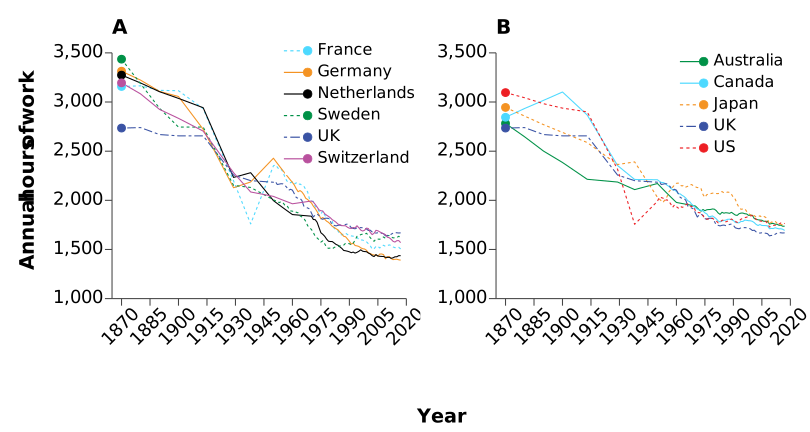 Figure 3.15: Annual working hours per worker (1870–2017)Working hours declined dramatically across nations since the late 19th century, falling over 50% in many countries.CORE Econ — The Economy, Ch. 3 → The internet freed us from information scarcity — and an entire economy of knowledge, creativity, and connection emerged.
Each time, what followed was not less activity but a profound reallocation of human energy toward higher-order pursuits.2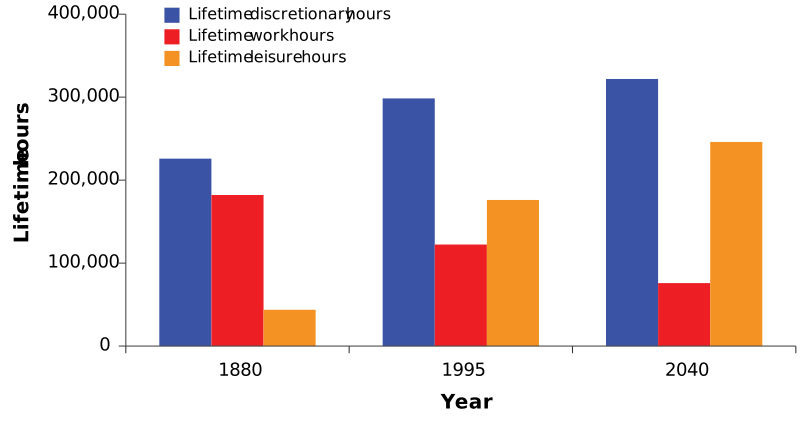 Figure 3.17: Estimated lifetime hours of work and leisure (1880–2040)Discretionary time has increased dramatically. By 2040, lifetime leisure hours are projected to far exceed work hours.CORE Econ — The Economy, Ch. 3 → And each time, the industries that shaped that reallocation became the defining economic forces of their era.
We are entering the largest such reallocation in history. AI and robotics can already automate more than half of all work hours in the United States — not as a future projection, but using technologies that exist today.3Superagency in the Workplace (2025)McKinsey Global Institute finds that AI agents and advanced robotics can already automate over 57% of U.S. work hours using currently available technologies.McKinsey Global Institute → When AI handles what must be done, and robotics serves as its physical extension, humanity gains the freedom to choose what it wants to do. As the imperative to survive recedes, the imperative to matter takes its place.
In 1943, Abraham Maslow described human motivation as a pyramid — survival at the base, self-actualization at the peak, reached only once everything below it was secured.4A Theory of Human Motivation (1943)Maslow's foundational paper proposing the hierarchy of needs, from physiological survival to self-actualization.Maslow, A.H. — Psychological Review → For most of history, that hierarchy held. Most people never got past the middle.
But when technology handles the base — when survival, safety, and routine labor are increasingly automated — the pyramid doesn't just open up. It inverts. The needs that were once aspirational luxuries — meaning, creativity, connection, identity, wellbeing — become the primary terrain of human life. Not the peak. The foundation.
As AI compresses routine cognitive and physical labor, it liberates time at a scale not seen since the industrial revolution. But liberated time without purpose creates a void. And AI outperforming humans across an expanding set of domains triggers something deeper than economic anxiety. It triggers an identity crisis.
This is not hypothetical. When people retire voluntarily — with financial security, at the end of a career — 28% experience depression.5Prevalence of Depression in Retirees: A Meta-AnalysisSystematic review finding that 28% of retirees experience clinically significant depression, with involuntary retirees at substantially higher risk.PMC / National Institutes of Health → When the departure is involuntary, the odds of depression increase by more than half.6Involuntary Retirement and Depression (2022)Meta-analysis of longitudinal studies finding involuntary retirement is associated with 52% increased odds of depression compared to voluntary retirement.PMC / National Institutes of Health → Now scale that to the hundreds of millions of workers worldwide projected to be displaced by AI within the decade.7AI & the Global WorkforceGoldman Sachs estimates AI could displace the equivalent of 300 million full-time jobs globally, with 26% of office roles highly exposed to automation.Goldman Sachs Research → A generation in its prime, who did not choose it, and whose security is anything but certain.
And yet, humanity will not stand still. The question of meaning, once reserved for philosophers, becomes a mass-market need. People will not stop striving — but what they strive for transforms. Not survival, but significance. Not productivity, but purpose.
The new paradigm is existential. Together, they describe a world where billions of people — across every demographic and geography — face the same questions and struggle almost at once: who am I here and what do I do?
This is not an abstract philosophical exercise. It is an economic one. When meaning becomes a mass-market need, the technologies and experiences that help people navigate it become the defining industries of the era. The demand for meaning, purpose, identity, health, connection, and creative expression is not emerging. It will be exploding — and the infrastructure to serve humanity in a global post-necessity society will be emerging now.
These four domains are not discrete categories. They are deeply interconnected — a single product, platform, or experience often spans two or three pillars simultaneously. The boundaries are intentional starting points for analysis, not walls between investments.
Play is no longer a leisure category. It is the dominant cultural operating system of our time. The interactive worlds that games pioneered are gaining capabilities at an extraordinary rate — advances in real-time rendering, generative AI, and spatial computing are producing environments of escalating fidelity and immersion, while blockchain enables fully functional digital economies with real ownership, trade, and value creation. These worlds increasingly function not just as entertainment, but as places where people socialize, learn, create, and build identity. What began as a subculture is becoming ambient infrastructure for daily life. As identity increasingly takes shape within these worlds, so too does purpose.
This transformation is not confined to screens. The same participatory logic that defines interactive worlds — agency, real-time feedback, identity expression — is reshaping live sports and physical spectacle. Stadiums are becoming immersive technology platforms where the boundary between athlete and audience dissolves. The concert, the arena, the run club — these are not alternatives to digital play but parallel expressions of a single synthetic reality, where the line between physical and digital experience ceases to matter. Across both domains, the direction is singular — from watching to doing.
As AI collapses the friction of creation, a new frontier emerges within play itself. The process of making — modding a world, producing a highlight, designing an experience — is becoming the product. We are entering the age of Craft Leisure, where authorship and agency are the scarce and valued experiences. The conviction lies in the full spectrum: the platforms that host these worlds, the technologies that make spectacle participatory, and the tools that turn every player into a creator. Play is no longer an escape from life — it is the arena where the future of human experience is being built.
As external survival demands recede, the internal challenges of existence come into sharp focus. The dissolution of traditional structures — career, routine, and status — has left a void that material abundance cannot fill. When the external world becomes fluid and automated, the internal stability of the human spirit becomes our most critical infrastructure.11Our Epidemic of Loneliness and Isolation (2023)Half of U.S. adults reported loneliness before COVID. Social disconnection carries mortality risk equivalent to smoking 15 cigarettes/day — establishing the crisis of the self as a clinical reality.U.S. Surgeon General →
This necessitates a shift from reactive treatment to proactive fortification. We are moving from a model of health defined by the absence of disease to one defined by the presence of resilience. This is the transition to "Inner Engineering" — the cultivation of mental clarity and emotional regulation as a daily practice rather than a crisis response.
We invest in the "software of the self" — digital sanctuaries and scalable mental infrastructure that democratize access to presence.12The $2 trillion global wellness market (2025)The U.S. wellness market exceeds $500B growing 4–5% annually. 84% of consumers say wellness is a top priority. Mental health and mindfulness are the categories where consumer needs remain most unmet.McKinsey & Company → The products that endure will be those where the metric that rises — a resilience score, a clarity streak, a measure of presence — attaches to the user's identity.13Digital Mental Health Market (2024–2025)The digital mental health market grew from $21B in 2024 to $25B in 2025, projected to reach $83B by 2032 at 19% CAGR. AI-driven therapy platforms, wearable biometrics, and employer-sponsored wellness are key growth vectors.Research & Markets → In an age where AI outperforms human cognition, our capacity for felt experience and emotional grounding is our most valuable asset. We invest in the shift from "Am I sick?" to "Am I optimized?" — the identity-forming work of mastering one's own consciousness.
The era of "education for utility" is ending. For generations, we learned to become economically productive. But as the utility of routine knowledge diminishes, the purpose of growth shifts: we are moving from learning to earn to learning to become.14Future of Jobs Report 202539% of core skills will change by 2030; 170M new roles created vs. 92M displaced. The fastest-growing skills blend AI literacy with creative thinking, resilience, curiosity, and lifelong learning.World Economic Forum → In a world of instant answers, human value moves from the retention of facts to the cultivation of wisdom, creativity, and judgment.
This fuels a new imperative for mastery. Without the external structure of a career to dictate development, growth becomes an act of personal agency. We are entering the age of the Polymath, where individuals pursue curiosity for its own sake. But a critical distinction emerges: the market for feeling productive may be larger than the market for being productive. We invest in technologies that deliver a genuine expansion of capability — tools that measurably close the gap between intention and ability,15Shaping the Future of Learning: AI in Education 4.0 (2024)AI as a catalyst for personalized, mastery-based education — supporting teachers, adapting to individual learning contours, and enabling lifelong skill development.World Economic Forum → rather than gamified loops that merely simulate progress.
True growth is now about the expansion of potential rather than the standardization of labor. We are building the scaffolding for a civilization that, for the first time in history, has the freedom to make self-mastery its primary occupation.16Skills Outlook 2025: From Learning Gaps to Earning GapsThe capacity to reskill and upskill has become the primary determinant of individual opportunity. When learning opportunities are unequally distributed, labor market differences widen across generations.OECD →
While we are more digitally linked than ever, we are socially fractured.17Our Epidemic of Loneliness and Isolation (2023)Half of U.S. adults experienced loneliness before COVID. Loneliness carries mortality risk equivalent to smoking 15 cigarettes/day. The advisory calls for strengthening social infrastructure and reforming digital environments.U.S. Surgeon General → The decline of physical "third places"18Loneliness epidemic: Bowling Alone, 25 years later (2025)Only ~50% of Americans regularly spend time in community public spaces in 2025, down from ~67% in 2019. Two in ten adults have no close friends outside family (vs. 3% in 1990).Fortune / Associated Press → and the "broadcast" model of the early internet have exacerbated isolation, replacing genuine connection with performative consumption.19One in Three Americans Feels Lonely Every Week (2024)30% of adults report weekly loneliness; 30% of 18–34 year olds are lonely daily. Only 3% selected online communities as a place of high belonging — direct evidence that broadcast-model platforms have failed.American Psychiatric Association → The antidote lies in a new generation of platforms designed for intimacy rather than audience — a migration from the public square to the Private Campfire.
The next era of social technology is about cultivating deep, meaningful tribes. This is the shift from "users" to "members," where the platforms that endure are those where belonging is a core component of identity. True connection is forged by doing things together under constraints that demand commitment. The run club, not the group chat; the guild, not the feed.
We invest in environments where communities co-create, govern themselves, and build shared culture. If healing stabilizes the individual, connection stabilizes society. We are weaving the isolated threads of a post-necessity world back into a cohesive whole through deliberate social architecture.
The technologies and experiences that serve this reallocation — across how people play, heal, grow, and connect — will define the next era of value creation.
The capability layers are being built: artificial intelligence, robotics, synthetic biology, advanced manufacturing, spatial computing. These are the foundations. But the change they create is overwhelming. Every breakthrough in AI, every leap in automation, every structure of default purpose dissolved — it accelerates the need for something on the other side. Not more technology for its own sake, but the technologies and platforms that help people navigate conscious living — that make it accessible, supported, and joyful rather than overwhelming.
That is where we invest. Not in the engine of disruption, but in the human response to it. The greater the disruption, the greater the need for what we build. This is not discretionary. It is necessity — in an era where the freedom to choose how we live expands dramatically.
The technologies that shape these answers will define the next era of value creation — and human flourishing.
